Different Types of Chainsaws + Buyer's Guide
3 months ago
For anyone who is not familiar with the basics of a powered chainsaw, this review is going to go over the topic in complete details of types of chainsaws. These are heavy-duty and powerful cutting tools that come fitted with really sharp teeth and these are fortified with a chain that allows users to cut through practically anything.
To better understand the origins of the mighty chainsaw let’s delve a bit deeper into its history. German surgeon Bernard Heine first made the device in 1830 and named it the Osteotome.
Of course, its original use was much more gruesome than what we use it for today as it was meant to be used during surgical operations as a handheld crank bone saw. Of course, soon thanks to the advent of better medicine, the use of the device changed considerably and became the normal chainsaw that we today.
Different Types of Chainsaws
As we have established over the previous paragraphs, there is not much difference in the general structure of chainsaws besides their main components and sizes. Usually what sets these power-driven cutting tools apart is what their power source is.
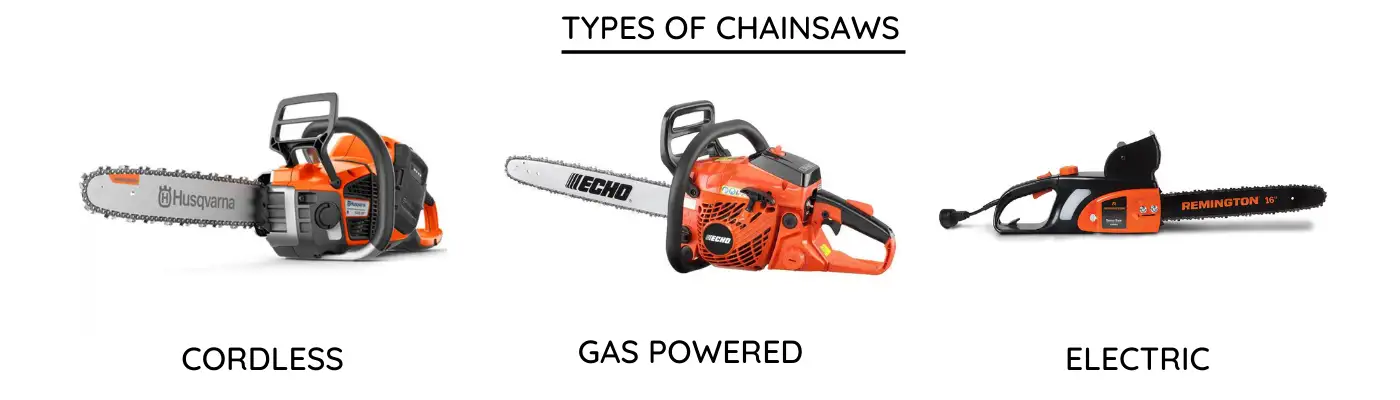
Between electric engines and gas-fueled engines, each has its arrangement of advantages but to find out what kind of chainsaw is best suited for your needs, you need to go over the main advantages and disadvantages first.
Let’s take a deeper look at the types of chainsaws.
Gas-Powered chainsaws
When we look at the features, the positives, and negatives of gas-controlled cutting saws we see that of course, the main feature is how much power they grant the user. You can’t beat the cutting force of a gas-powered chainsaw.
However, with the more amount of power comes a greater amount of noise too. They also emit toxic fumes and gases which are bad for the environment and the user's health. The expanded size additionally implies they are heavier than most and can be difficult to maneuver if you don’t have some experience.
Of course, because you are getting to work with a very powerful device, you will soon realize that it takes a lot of gas and fuel to power this. It means you have the additional costs of refueling it constantly and this also means there is more need for maintenance in the longer run.
That’s not all, however, because, with refueling, it implies that users must have the knowledge on how to mix the right amounts of motor oil to grease which is crucial to ensure motor health. This is not a task that just about anyone can do and it takes experience. However, if the user doesn’t learn how to then they risk incurring the additional cost of hiring professionals to do it.
This is super important to get right because if the balance is off, it could mean that your motor might malfunction or be seriously harmed in the process.
Electric-Powered Chainsaws
Chainsaw tools that are electric-fueled are available in 2 kinds; the corded variety and the battery-controlled ones. Battery-fueled cutting tools are not super popular or common, as the idea of being controlled by a battery limits both their capacity and the measure of time you can work in one go.
When we talk about the corded electric cutting tools, we see that these offer favorable features when compared to their gas-fueled partners. Of course, the most prominent feature is that they are better for the environment as they do not use fossil fuels and also do not emit toxic fumes. They are also much quieter than their gas counterparts. There are fewer amounts of vibration that occurs and this means users will be able to use them more peacefully.
Since you do not have to continually fill them up with gas or fuel, corded electric saws, this means that electric versions are way more affordable in the longer run. This also means that they will work much longer since fuel runs out but electricity does not. However, as a drawback, they do not have the necessary torque to beat a gas-powered model and are usually smaller in size.
When we look at the design of electric powered machines, we see that it doesn’t cause as much friction and thus does not need any lubrication to work efficiently. Most electric models are already lubricated and this will last for life.
Cordless Electric Chainsaws
For users that are keen on having the ease and convenience of transportability and invest in a kind of device that is far better for the environment along with not being confined by the limitations of expensive refueling of gas or oil-based power sources, the cordless electric chainsaw might be the best bet for you.
Cordless cutting apparatuses run off of a battery-powered power source, much the same as a cordless drill. A significant disadvantage of cordless cutting tools is that since they run on batteries, users will have to keep buying new batteries. This also means you will have a restricted measure of time to work before the time has come to energize or replace your battery comes up.
However, as an advantage, these devices are usually super quiet and are only in a range of about 80 to 95 decibels. They can also come fitted with brush-less engines that make them as strong as the same number of their gas-controlled counterparts without the issues that come with refueling or loud noises.
There are 3 major types of chainsaws regarding size that users can select to get the perfect kind of chainsaw for them. Bear in mind that always figure out what you are going to be using the device for. Then select one and make your purchase, otherwise, you might get a product that is not the right kind for you and you may end up causing more damage than good.
Mini-sized chainsaw
The mini variety of chainsaw is usually fitted with a handy guide bar that may have a length of about somewhere between 12 and 14 inches. The reason why these chainsaws are so small is that they are fitted with a motor that can have a capacity of around 30 to 40cc. of course, since these are smaller, they are usually meant for at-home users more than pros but that does not mean that you won’t get the powerful punch that you need to get your maintenance work done.
Mid-sized chainsaws
Mid-size tools come fitted with a guide bar length in the scope of 16 to 24 inches and are powered by engines that go up to the 40 to 60cc range. While they are also not heavy-duty devices, they are still a smidgen more impressive than your small scale versions and are fit for dealing with bigger and thicker foliage.
The best thing about this size is that it can still be managed with enough stability and maneuverability if you are inexperienced, however, this will get you the serious power you need to deal with bigger jobs and tasks. So it is a good idea for professionals as well.
Large-sized chainsaws
These larger cutting tools are much bigger in size and power when compared to their little and medium-size contenders which are partly why these are not meant to be used by amateurs or inexperienced users. These heavy-duty contraptions are best left to the experts such as lumbering experts and professional tree fellers who need that power and range. Their guide bar length is anything more than 24 feet long, and their engine's capacity can go up from 60cc to 120cc.
These models are commonly meant to be used for heavy-duty uses and are a serious hazard for any individual who isn't viewed as an expert. Simply lifting these models off the ground can be an exercise all by itself, not to mention working them can be a serious workout.
Uses of a chainsaw
Perhaps the most widely known uses for these devices are for cutting up timer and trees for the wood industry. It is also a popular choice of gardeners and landscapers who use it to maintain, hedge, and trim vast gardens, trees, branches, and hedges. It can also be sued to cut up wood for firewood and can even be sued to cut up practically anything.
Of course, it is crucial to remember that chainsaws are not exactly the safest to use and require a ton of experience. There are added safety features included to make the process safer but you still should have some practice before you use it.
Main Features of a Chainsaw
Several different kinds of handles are usually attached to the main body where the motor usually is and this is a very important feature as this is where your entire grip will be on the device. The main handle is, of course, the most important one as it controls the startup of the machine using the power trigger. To get the best grip and to provide the right kind of balance required, there is a subsequent handle commonly situated over the highest point of the machine and this, of course, is crucial since, without it, the chainsaw could go flying out of the user’s hands and be potentially dangerous.
The cool thing about chainsaws is that they come in a wide range of products and kinds so there is a choice for all users. These tools can be either gas-fueled or electric controlled. They may also be powered by a battery and we will be looking into each variety in more detail further down this review. When it comes to more power and bigger sizes, there is no denying that none can beat gas-fueled models however they are not the best for the environment and in some cases, the user.
On the other hand, while electric models will, in general, be calmer and can at times offer more accuracy, they are not as powerful and will need a cord as well. Finally, battery-powered ones are also great for use but the issue with them is that they will require consistent battery changes that will be an additional cost. The same can be said for fuel in gas-powered ones.
Moving onto the engine itself, if gas-fueled, it is most likely that there will be a two-stroke engine. This implies that the motor will run on a combination of gas and motor oil and of course this is an additional and consistent cost. You will also need to make sure that you always get the absolute right consistency and proportion each time you mix them in. if not, it can affect the efficiency and performance of your device especially over a longer period.
Getting this present combination's proportion right will assist with keeping your saw running great and expand its life expectancy. Another issue with this kind of engine is that you will have to prep them for longer to get them to start.
Buyer's Guide - How to Buy The Best Chainsaw
The first component of a chainsaw that we discuss has to be the guide bar. This is called the base of the entire device as it is a crucial element. It is the length of the added guide bar which will determine what kind and range of cutting the chainsaw can accomplish. These lengths may range from anywhere from 6 inches to 72 inches and that depends entirely on the size of the device.

The process is fairly simple as the chain will rotate along the guide bar since they are attached. If you are looking for a device that is perfect for normal at-home usage, then you will get a length between 6 to 20 inches. Anything beyond that is meant for professional and heavy-duty use.
Handle and its Position
The handle is of course as we mentioned earlier super important because, without it, the user would not be able to hold and control the device. Most chainsaws come with two handle positions which are the rear handle and the top handle.
The rear handle variety is super common and this is what makes them ideal for both at-home and professional usage. Without the addition of a handle, the user would find it extremely difficult to cut anything since the device would go flying out and even damage the user or property.
The top handle variety is usually meant for expert and professional use and they are trickier to handle so they must only be used while in elevated positions and you have to make sure you are completely secure while doing so.
Chain Oiler
The next component is the chain oiler and this, of course, is a vital element since chainsaws are made of metal and metal needs to be oiled for it to function efficiently. The oiler is responsible for oiling the chain and thus has the duty of increasing the life of the chainsaw.
The need for a chain oiler becomes evident when you realize how much friction occurs when the guide bar and the chain move. This also produces a ton of heat so if there is not enough lubrication, there is more chance of kickback which is super dangerous. The life of the guide bar and chain will also be reduced considerably and these will have to be replaced. Finally, there could be considerable damage to the engine or motor.
Chains
Of course, we saved the most crucial component for last! A chainsaw is nothing without its chain and the important thing to remember is that chains can be of various types and forms. To accurately attach the correct size of chainsaw chains, you must familiarize yourself with measurements of the gauge, the number of drive links, and the pitch.
The pitch measurements are important as they show the user how close the drive links are on the main chain body. Sizes for these chains can be ¼ inches, .325 inches, 3/8 inches, 3/8 inches low-profile, and .404 inches. Second, we have the gauge which refers to the total width of the drive links and sizes in this include length of .043 inches, .050 inches, .058 inches, and .063 inches.
Lastly, the number of drive links is found by tallying the individual connections on the chain. This number is vital for getting the right chain for a replacement since general length estimations are not always interchangeable.
Battery
Battery-powered chainsaws usually are fitted with lithium-ion batteries and these are super powerful batteries as compared to previously used nickel-cadmium batteries. The use of lithium-ion technology has also made battery-powered alternatives much more popular thanks to the longer use times.
The best thing about lithium-ion batteries is that they can be charged in about an hour and give out way more power. These are also lighter as compared to electric or gas-powered ones.
Size and Weight
The size and weight of cordless chainsaws are usually in the moderate range as they are almost the same as gas-powered saws. This means they are way heavier than an electric chainsaw. While a fueled gas-engine device will come in around 12 pounds if it has an 18-inch, a cordless version will weigh about the same amount as well.
Power of the engine
Battery-powered devices have different motors and the most common is the brushless motor variety. Since like other cordless power tools, brushless motors work with way less friction, they are also more efficient in terms of use. This means that they will keep running for longer times as well since they need less recharging.
Maintenance of chainsaw
Maintaining and cleaning your chainsaw is one of the most vital steps to ensuring that you get the most of your device. Anything from dust, to dirt, and debris may be potentially damaging to your device especially since chainsaws have nooks and crannies where it can hide and eventually clog up the entire system. To prevent issues and clogging, the easiest way is to commit to a dedicated cleaning technique after each use.
Chain Lubrication
The lubrication of the chain is, of course, another important element as this will stand between the longevity of your device and complete rusting up or corrosion. Since there is a lot of friction between the chain and the guide bar when the machine is being run, you need oil or grease to act as a lubricant in between so that you have that high cutting power and efficiency.
Storing it properly
Finally, while this may not seem like a really important element, the way you store your chainsaw can have a serious effect on how well maintained it is. Chainsaws are not the cleverest designs as the chain is mostly exposed at all times and since this chain is made from some form of metal, that means it needs to be oiled or lubricated.
Being exposed to air, moisture and heat also means that the chain might expand or be more susceptible to corrosion and it may even dull down if it is not polished. So, it is crucial to store the device in a place where it is kept cooler and drier. Another tip is to keep it encased within a sheath made of cloth or rubber.